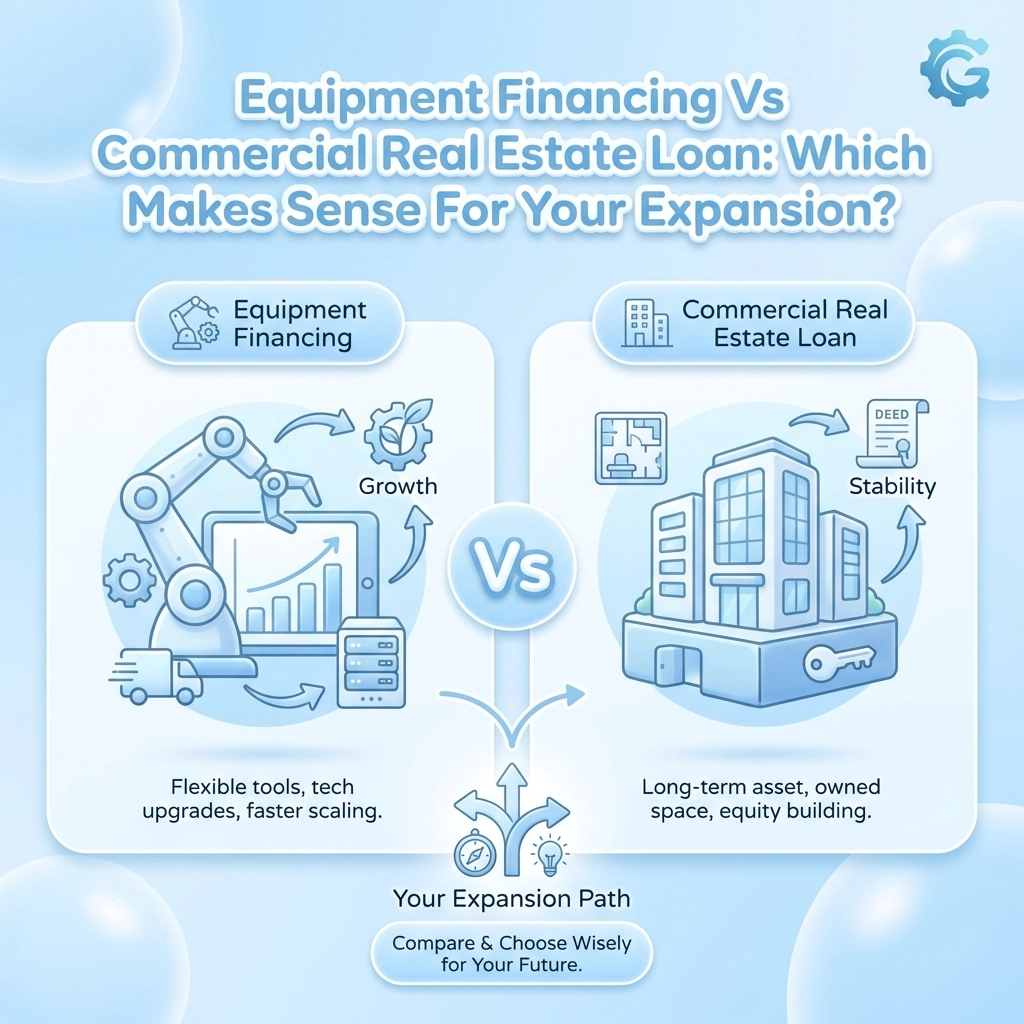
You're ready to grow. The demand is there, your team is ready, and you can practically see the next level of your business on the horizon. But here's where it gets tricky: should you invest in new equipment to scale operations, or is it time to lock down a physical location that gives you room to expand?
Both equipment financing and commercial real estate loans can fuel serious growth. But they work very differently, and choosing the wrong one could tie up your capital when you need it most.
Let's break down exactly what each option offers, when each makes sense, and how to figure out which path fits your expansion strategy.
What Is Equipment Financing?
Equipment financing is exactly what it sounds like: a loan specifically designed to help you purchase machinery, technology, vehicles, or other capital equipment your business needs to operate or grow.
Here's how it typically works:
- Loan amounts: Usually range from $5,000 to $5 million+, depending on the equipment
- Terms: Typically 2-7 years, matched to the useful life of the equipment
- Down payment: Some lenders require 10-20% upfront, though 100% financing options exist
- Collateral: The equipment itself secures the loan
The big advantage? You own the equipment outright once you pay off the loan. That means you build equity in an asset you can use, sell, or leverage for future financing.

What Lenders Really Look For
When you apply for equipment financing, lenders focus on a few key factors:
- Your business revenue: Most want to see at least $100K-$250K in annual revenue
- Time in business: 1-2 years minimum for most traditional lenders
- Credit score: 600+ for many options, though 680+ gets you better rates
- The equipment's value: Newer equipment with longer useful life = easier approval
Want to dig deeper into how equipment financing approvals actually work? Check out our post on equipment financing secrets revealed.
What Is a Commercial Real Estate Loan?
A commercial real estate (CRE) loan helps you purchase, develop, or renovate property for business use. We're talking office buildings, warehouses, retail spaces, manufacturing facilities: any real estate that serves your business operations.
The basics:
- Loan amounts: Typically $250,000 to $5 million+ for small to mid-sized businesses
- Terms: 5-25 years, with some loans amortized over 25-30 years
- Down payment: Usually 10-30% of the property value
- Collateral: The property itself secures the loan
Commercial real estate loans are a bigger commitment. But they also offer something equipment can't: a physical location that can appreciate in value while giving you a permanent base for operations.

The Real Requirements
CRE loans have stricter qualification standards than equipment financing:
- Credit score: Most lenders want 680+ for competitive rates
- Down payment: Plan for 20-25% in most cases
- Debt service coverage ratio (DSCR): Lenders want to see your business income covers 1.25x the loan payment
- Business financials: Expect to provide 2-3 years of tax returns and detailed financial statements
The Key Differences at a Glance
| Factor | Equipment Financing | Commercial Real Estate Loan |
|---|---|---|
| Typical Amount | $5K – $5M | $250K – $5M+ |
| Term Length | 2-7 years | 5-25 years |
| Down Payment | 0-20% | 10-30% |
| Approval Speed | Days to weeks | Weeks to months |
| Collateral | The equipment | The property |
| Asset Appreciation | Depreciates | Can appreciate |
Here's the straight talk: equipment financing is faster, more flexible, and requires less cash upfront. Commercial real estate loans take longer but build long-term wealth through property ownership.
When Equipment Financing Makes Sense for Your Expansion
Equipment financing is your move when growth depends on what you can do, not where you do it.
Choose equipment financing if:
-
You need to increase production capacity. New machinery, additional vehicles, or upgraded technology lets you handle more orders without moving locations.
-
Your current space works fine. If you've got room to grow where you are, pouring money into real estate doesn't make sense yet.
-
Speed matters. Equipment financing can close in days or weeks. If you've got a contract to fulfill or a seasonal opportunity to capture, waiting 60-90 days for a real estate loan could cost you.
-
You want to preserve cash. With 100% financing options available, you can acquire equipment without draining your reserves.
-
The equipment will pay for itself. If that new CNC machine or delivery truck will generate enough revenue to cover the payments and then some, the math works in your favor.

A Real-World Example
Let's say you run a commercial printing company. Demand has doubled, but your current equipment can't keep up. You could:
A) Buy a new building with room for more equipment (CRE loan: $800K, 25% down = $200K out of pocket, 90-day close)
B) Finance two new high-speed printers (Equipment financing: $150K, minimal down payment, 2-week close)
Option B gets you producing faster, preserves your cash, and doesn't lock you into a long-term real estate commitment until you're certain the growth is sustainable.
When a Commercial Real Estate Loan Makes Sense
Commercial real estate loans are your move when location is the bottleneck: or when owning property is a strategic advantage for your business.
Choose a CRE loan if:
-
You've outgrown your space. If you're turning away business because you physically can't fit more inventory, equipment, or employees, it's time.
-
You're paying premium rent. When monthly rent approaches what a mortgage payment would be, ownership starts making financial sense.
-
Location is a competitive advantage. Retail businesses, restaurants, and service providers often depend on being in the right spot.
-
You want to build long-term wealth. Real estate typically appreciates over time. Your equipment won't.
-
You need specialized facilities. Manufacturing, cold storage, or other specialized operations sometimes require purpose-built spaces that are hard to lease.
The Wealth-Building Angle
Here's something business owners often overlook: commercial property can become a retirement asset. Buy a building, pay it off over 20 years, and you've got an asset worth potentially millions that generates rental income or can be sold.
Equipment? It depreciates. That $500K piece of machinery might be worth $50K in 10 years. But that $500K building? It could be worth $750K or more.
Questions to Ask Yourself Before Deciding
Before you commit to either path, get honest with yourself about these questions:
-
What's actually limiting my growth right now? Is it capacity (equipment) or space (real estate)?
-
How much cash can I put down? If you're light on reserves, equipment financing's lower down payment requirements might be the practical choice.
-
How quickly do I need to move? Real estate deals take time. Equipment financing is faster.
-
What's my 5-year plan? If you might relocate or pivot, locking into real estate could backfire.
-
Can I afford both? Some businesses stage their expansion: equipment first to boost revenue, then real estate once cash flow supports a bigger commitment.

The Bottom Line
There's no universal right answer here. Equipment financing and commercial real estate loans both serve legitimate expansion strategies: they just solve different problems.
Go with equipment financing when you need to boost capacity, move quickly, or preserve cash while your current location still works.
Go with a commercial real estate loan when you've genuinely outgrown your space, want to build long-term property equity, or need a specialized facility that's hard to lease.
And remember: these aren't mutually exclusive. Many growing businesses use equipment financing to boost revenue first, then leverage that increased cash flow to qualify for a commercial real estate loan later.
Not sure which direction makes sense for your specific situation? That's exactly what we help business owners figure out every day. Explore your funding options or reach out to our team to talk through your expansion strategy.
This content is for educational purposes and shouldn't be considered financial advice. Loan terms, rates, and qualification requirements vary by lender and your specific business situation. Always consult with a financial professional before making major funding decisions.
Leave a Reply