
You’ve done the hard part. You’ve moved past the "is this a hobby?" phase and pushed your business into the $30,000+ monthly revenue bracket. At this stage, you aren't just surviving; you’re scaling. But as any business owner at this level knows, growth is a hungry beast. It requires fuel, usually in the form of cash.
Maybe you have a massive purchase order you can’t quite fulfill with your current cash on hand. Or perhaps you’ve spotted a gap in the market that requires an immediate inventory boost. The dilemma isn't whether you need funding; it’s which type of funding will help you scale without drowning you in red tape or restrictive debt.
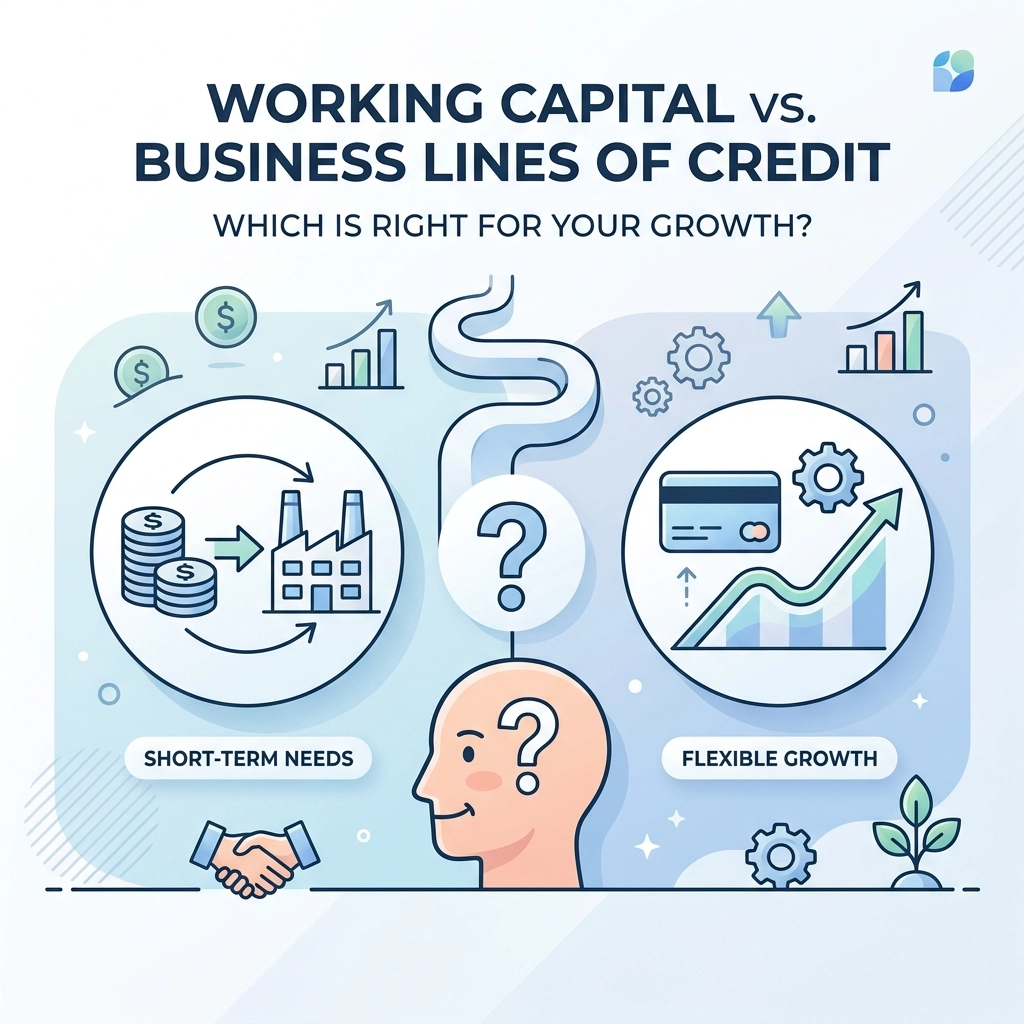
In the world of small business growth financing, two heavyweights dominate the conversation: Working Capital (often structured as Revenue-Based Funding) and Business Lines of Credit.
At Loan Pros, we see thousands of "finance-ready" businesses every month. Many of our clients are actually overqualified for the basic loans they think they need. Because you have consistent revenue, you have leverage. But to use that leverage correctly, you need to understand which tool fits the job.
The Universal Floor: Are You Ready for Funding?
Before we dive into the comparison, let’s talk about the baseline. If you’re reading this and wondering if you qualify for professional-grade funding, here is the "Universal Floor" we look for at Loan Pros. To access our network of 75+ lenders, your business must meet these four criteria:
- $30,000+ Monthly Gross Revenue: Your business must consistently generate at least $30k per month.
- 6 Months in Business: Your business must be operating for at least six months.
- A Business Checking Account: Personal accounts are a no-go. You need a clean trail of business transactions.
- U.S.-Based Business: You must be operating within the United States.
If you meet these marks, you aren't just "looking for a loan", you are a qualified candidate for growth capital.

Working Capital (Revenue-Based Funding): The Speed Demon
When people talk about a working capital loan or revenue-based funding, they are usually referring to a lump sum of cash delivered quickly, with repayment terms tied to your business's daily or weekly sales.
This isn't your grandfather’s bank loan that takes six months to approve. This is built for the modern, fast-moving business.
How it Works
A lender provides you with a lump sum, say $25,000 based on your $30k monthly revenue, and you pay it back over a fixed period (usually 6 to 18 months). Instead of a traditional interest rate, these often use a "factor rate." You know exactly what the total payback amount is on day one.
The Pros
- Speed is King: In many cases, you can get funded in 24 to 48 hours. If you have an inventory deal that expires on Friday, this is your solution.
- Accessible Credit Standards: Because the funding is based on your revenue ($30k+/mo), lenders are often more concerned with your bank statements than a perfect credit score.
- No Collateral: Most revenue-based funding is unsecured, meaning you aren't putting your house on the line to buy more widgets.
The Cons
- Fixed Cost: You pay the full cost of the capital regardless of how fast you pay it back.
- Daily/Weekly Remittances: Most of these products pull payments directly from your bank account daily or weekly. This requires disciplined cash flow management.
Best Use Cases
Working capital is perfect for "Project-Based" growth. Use it when you have a specific, high-ROI opportunity that needs cash now. Think: bulk inventory discounts, seasonal hiring, or quick equipment repairs.
Business Lines of Credit: The Safety Net
A Business Line of Credit (LOC) is much more like a high-limit credit card, but with better rates and higher limits. It’s a revolving pool of funds you can tap into whenever you need it.
How it Works
A lender approves you for a maximum limit, for example, $50,000. You don't have to take all $50,000 today. You can draw $5,000 to cover a payroll gap, pay it back, and then that $5,000 is available for you to use again later.
The Pros
- Unmatched Flexibility: You only pay interest on the money you actually draw. If your balance is zero, your cost is usually zero.
- Long-Term Utility: Once you’re approved, the line is there for you. It grows with your business.
- Lower Overall Cost: For businesses with fluctuating needs, an LOC is often the most cost-effective way to manage "just in case" scenarios.
The Cons
- Stricter Underwriting: Lenders usually want to see a stronger credit profile for an LOC than they do for revenue-based funding.
- Lower Initial Limits: You might qualify for a $30,000 working capital loan but only a $15,000 line of credit initially.
- Maintenance: Some lenders require annual renewals or "cleanup" periods where the balance must hit zero.
Best Use Cases
Lines of credit are for "Operational" growth. Use them to manage accounts receivable gaps (when you’re waiting 30 days for a client to pay) or to provide a cushion for recurring monthly expenses during a lean month.

The Comparison: Which One Matches Your Growth?
Choosing between the two depends entirely on why you need the money. Let’s look at how they stack up for a business doing $30k monthly revenue with at least 6 months in business.
| Feature | Working Capital (Revenue-Based) | Business Line of Credit |
|---|---|---|
| Primary Goal | Specific expansion/project | Ongoing cash flow management |
| Funding Speed | Extremely Fast (24-48 hours) | Moderate (7-14 days for initial setup) |
| Repayment | Fixed daily/weekly payments | Flexible monthly payments |
| Cost Structure | Fixed "Factor Rate" | Variable Interest Rate |
| Collateral | Usually none | May require a lien on assets |
| Paperwork | Minimal (6 months bank statements) | More intensive (Tax returns, P&L) |
Pro-tip: Many of our most successful clients actually use both. They keep a Line of Credit for emergencies and use Working Capital loans for big, strategic moves.
The $30k Monthly Revenue Milestone
Once you hit that $30,000 monthly revenue mark, you enter a new tier of lending. You are no longer considered a "high risk" in the eyes of many alternative lenders. At this level, you should be looking for a $30k monthly revenue loan that offers more competitive terms.
Don't fall into the trap of thinking you have to take whatever is offered. Because you have the revenue, you are "finance-ready." This is where Loan Pros excels. Instead of you begging one bank for a loan, we put your $30k/mo track record in front of a network of 75+ lenders. We make them compete for your business.
To learn more about how we evaluate your business health, check out our guide on What Lenders Look for.
How Loan Pros Helps You Choose
The biggest mistake business owners make is choosing a funding product based on a Google ad rather than their actual business data.
At Loan Pros, we act as a capital matchmaker. We don't just give you a "yes" or "no." We look at your $30k+/mo revenue, your time in business, and your specific goals. Because we work with over 75 lenders, we can often find both a working capital option and a line of credit option for the same business, letting you choose the one that feels right.
Remember: Overqualified = Qualified. If your business is healthy, you have the power to choose. You shouldn't be settling for "predatory" terms or high-interest "payday" style loans. You deserve professional financial services that respect your growth trajectory.

Action Steps: What Should You Do Today?
If you are ready to take that next step from $30k to $50k or $100k a month, here is your roadmap:
- Gather Your Data: Pull your last 6 months of business bank statements. Ensure your business bank account is separate from your personal one.
- Confirm You Meet the Floor: Make sure you are at $30k+ in monthly gross revenue, 6+ months in business, have a dedicated business checking account, and operate a U.S.-based business.
- Identify the Use Case: Are you buying something specific (Working Capital) or do you just need a safety net (Line of Credit)?
- Consult the Experts: Read through our Smart Biz Funding Guide to see which path aligns with your long-term strategy.
- Apply with Confidence: Don't guess which lender will accept you. Use a network that does the legwork for you.
Growth doesn't happen by accident. It happens when you have the right tools at the right time. Whether it’s the lightning-fast speed of revenue-based funding or the steady reliability of a line of credit, the capital you need is accessible: as long as you meet the floor.
Are you ready to see what your $30k+ monthly revenue can unlock?
Apply Now at Loan Pros and get matched with the right funding for your growth.
Disclaimer: All funding is subject to lender approval. Loan Pros is a financial services marketplace and not a direct lender. Terms and rates vary based on business performance, credit history, and lender criteria. Always consult with a financial advisor before taking on new business debt.
Leave a Reply